Die Nebel der Sterne lüften

Die Nebel der Sterne lüften

In Doppelsternsystemen geht es auf Dauer selten friedlich zu. Irgendwann fängt ein Stern an, dem anderen Materie zu klauen. Am Ende steht oft eine große Zerstörung. Und ein farbenprächtiger Nebel.

Das Hubble-Weltraumteleskop verwöhnt unsere Augen immer wieder mit hochauflösenden Bildern aus dem All. Wohl kaum jemand kann sich der Faszination von Aufnahmen entziehen, auf denen farbenreiche Schleier über sternklare Himmel tanzen. Auch Kerstin Weis und Dominik Bomans nicht. Die beiden forschen am Astronomischen Institut der Ruhr-Universität Bochum und betrachten die Gebilde nicht nur aus ästhetischen Gründen gern. In ihrer Arbeit entschlüsseln sie die physikalischen Prozesse, die zur Bildung der Nebel führen. Gerade in Doppelsternsystemen finden sie interessante Effekte, wenn ein Stern dem anderen Materie klaut.

Doppelsterne umkreisen sich gegenseitig, sind aber selten gleich groß. Das hat Konsequenzen für ihre Entwicklung. Denn: „Je massereicher ein Stern ist, desto schneller altert er“, sagt Prof. Dr. Dominik Bomans. Im Alter blähen sich Sterne zu sogenannten Roten Riesen auf. In Doppelsternsystemen können sie dadurch in das Gravitationsfeld ihres Begleitsterns geraten, sodass Materie vom Roten Riesen auf den Partner überfließen kann, was in der Regel in einer große Helligkeitsexplosion endet, einer Nova.

Bessel-Preis für Benjamin Joachimi: Förderung für internationale Zusammenarbeit in der Kosmologie

Bessel-Preis für Benjamin Joachimi: Förderung für internationale Zusammenarbeit in der Kosmologie

Die Fakultät für Physik und Astronomie freut sich, bekannt zu geben, dass Prof. Benjamin Joachimi mit dem Friedrich Wilhelm Bessel-Forschungspreisausgezeichnet wurde. Die Alexander von Humboldt-Stiftung verleiht den Preis jährlich an etwa 20 international anerkannte Wissenschaftler*innen aus dem Ausland für ihre besonderen Forschungsleistungen. Der Preis ist mit 60.000 Euro dotiert. Nominiert wurde der Kosmologe von Prof. Hendrik Hildebrandt und Prof. Catherine Heymans. Für Joachimi, der Professor für Astrophysik am University College London ist, und unsere Fakultät heißt das, dass sie ihre enge Zusammenarbeit in Zukunft noch intensivieren können – unter anderem durch Forschungsaufenthalte Joachimis in Bochum, von denen der erste für Sommer 2026 geplant ist.
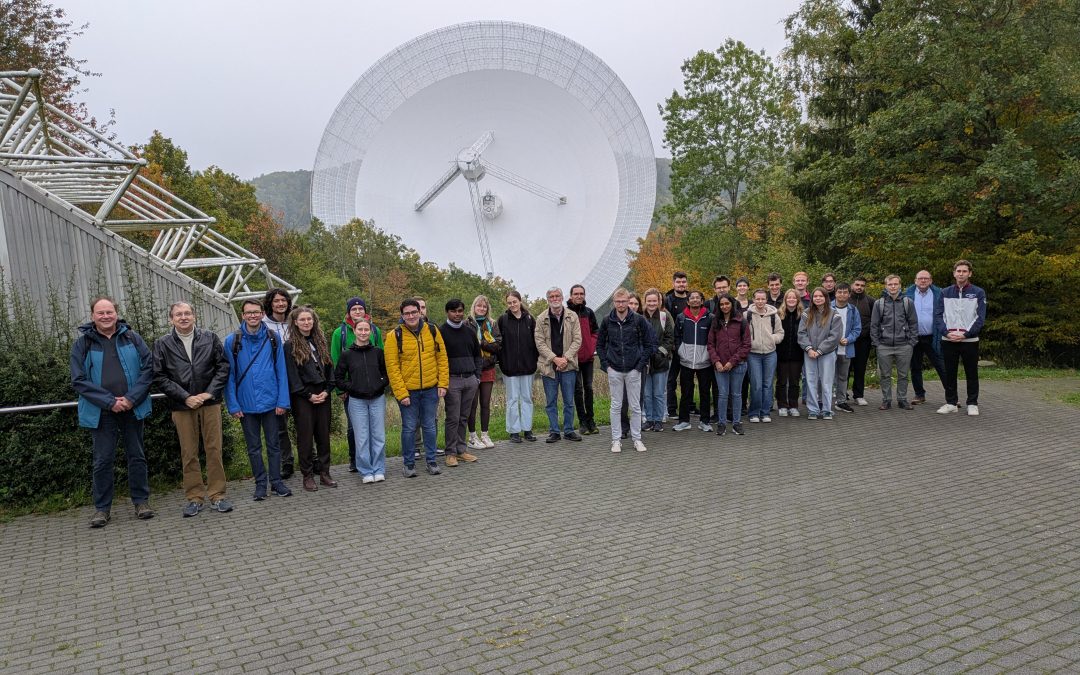
 

Exkursion zum 100-m-Radioteleskop in Effelsberg

Exkursion zum 100-m-Radioteleskop in Effelsberg

Am 11. Oktober 2025 fand eine Exkursion zum 100-m-Radioteleskop in Effelsberg sowie zur LOFAR-Station des Max-Planck-Instituts für Radioastronomie (MPIfR) statt.
Teilgenommen haben Studierende der Veranstaltungen „Instrumente und Beobachtungsmethoden“ (WiSe 2024/25) sowie „Introduction to Astrophysics“ (SoSe 2025). Eine weitere Exkursion nach Effelsberg ist bereits für den Frühsommer 2026 in Planung.
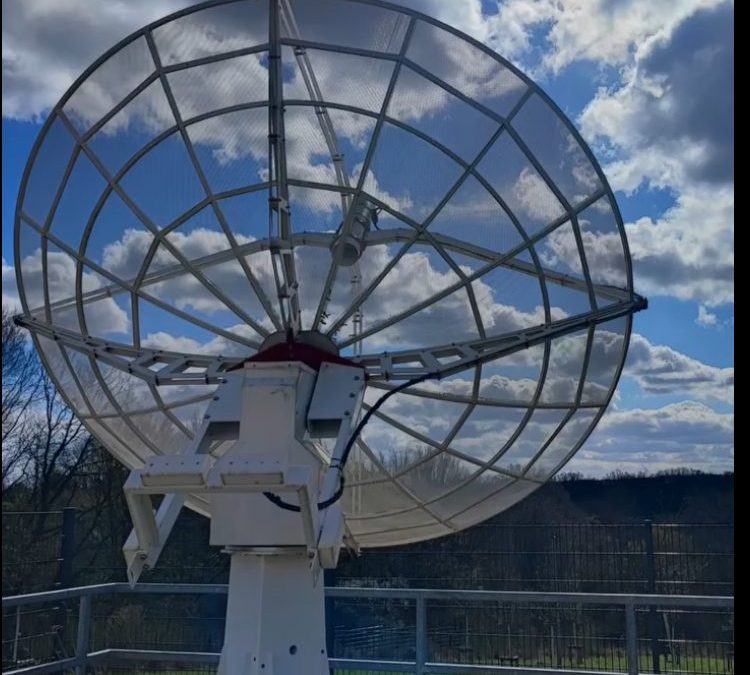
Beobachtung am RUB Campus-Observatorium

Beobachtung am RUB Campus-Observatorium

In der Langen Nacht der Astronomie laden die Stiftung Planetarium Berlin, die Gesellschaft Deutschsprachiger Planetarien und die Vereinigung der Sternfreunde gemeinsam mit zahlreichen astronomischen Einrichtungen deutschlandweit dazu ein, mit einem abwechslungsreichen Programm die Begeisterung für die Astronomie zu teilen.

Am 13. September 2025 laden wir von 17:00 bis 21:00 Uhr zu einer spannenden Beobachtungsveranstaltung am RUB Campus-Observatorium ein.

Der Treffpunkt ist am Südrand des Campus, unterhalb des Parkplatzes der Campus-Sporthalle (CASPO). Die Teilnahme ist kostenfrei. Bei klarem Himmel bieten wir visuelle Beobachtungen mit dem AIRUB-40cm-Teleskop an, bei denen Planeten, Sternhaufen und weitere Himmelsobjekte betrachtet werden können. Außerdem gibt es kurze Führungen zu unseren aktuellen Forschungsinstrumenten sowie zum Radio-Teleskop. Mehrere Astronom*innen sind vor Ort und beantworten gerne alle Fragen rund um die Astronomie. Sollte das Wetter nicht mitspielen, finden Führungen durch die Kuppeln statt. Die Veranstaltung dauert etwa vier Stunden und wird auf Deutsch und Englisch angeboten.

Live im Planetarium: Die ersten Bilder des Vera Rubin Observatoriums

Live im Planetarium: Die ersten Bilder des Vera Rubin Observatoriums

Am Montag, dem 23. Juni, um 16:30 Uhr sind alle Interessierten ins Bochumer Planetarium eingeladen, um bei der Veröffentlichung der ersten Bilder des Rubin Observatoriums, das in Chile in Betrieb geht, dabei zu sein. Durch das Programm führen Prof. Hendrik Hildebrandt von der Ruhr-Universität, der die Ergebnisse der neuen Riesenteleskops für seine Forschung nutzen wird, und Prof. Susanne Hüttemeister vom Planetarium Bochum.

Kilo-Degree Survey Confirms Standard Model of Cosmology

Kilo-Degree Survey Confirms Standard Model of Cosmology


The Kilo-Degree Survey has taken images of 41 million galaxies in its eight years of observation. This image shows a section of the data set. © Konrad Kuijken and the KiDS team. Based on HEALPix sky tessellation

An international research team has analyzed data from 41 million galaxies in order to estimate the distribution of matter in the universe. The data confirm a long-established model – much to the team’s surprise.

The Kilo-Degree Survey (KiDS) has been observing large parts of the southern sky over a period of eight years in order to gain valuable new insights into the distribution of matter in the universe. On March 18, 2025, the final data set “KiDS-Legacy” was published under the leadership of researchers from Bochum, Leiden, Edinburgh, Newcastle, and London. Previous KiDS analyses had cast doubt on the standard model of cosmology: The data had suggested a more uniform distribution of matter than the standard model predicts based on measurements from the Planck satellite. However, after analyzing the now complete KiDS data set with improved methods and calibration data, the results are consistent with the

standard model, which describes how the Universe and structures within evolved over cosmic time.

“We took great care to optimize all parts of our analysis, which was a time-consuming process,” says Dr. Angus Wright from Ruhr University Bochum, Germany. “The fact that the result now deviates so much from our previous analyses came as a surprise – but we were able to identify the reasons behind these changes.” The final evaluation is described in five publications that have been published or submitted for publication in the journal “Astronomy & Astrophysics”. All papers are accessible via the document server arXiv since March 26, 2025.

Determining the matter distribution with gravitational lensing

There are various methods for determining the density and structure of matter. The KiDS team used gravitational lensing in this instance: Massive objects deflect the light from distant galaxies so that these galaxies appear in a distorted shape and in a different place than they actually are when viewed from Earth. Cosmologists can use these distortions to estimate the mass of the deflecting objects and, ultimately, the total mass of the Universe. “The major advantage over other methods is that gravitational lensing can also be used to detect the dominant dark matter and make it visible, so to speak,” explains Dr. Robert Reischke from the University of Bonn.

To this end, the researchers need to know quantities such as the distances between the light source, the deflecting object and the observer. The researchers make use of the redshift to calculate these factors; redshift describes an effect where light shifts more and more towards longer wavelengths as it travels from more distant galaxies through the expanding Universe before it reaches Earth.

Images of 41 million galaxies taken with the Very Large Telescope Survey Telescope were included in the analysis. The KiDS data covers an area of 1,347 square degrees of the sky, i.e., almost ten percent of the sky where we can see past our own Galaxy.

Calculating the distance of galaxies based on redshift

In order to determine the redshift of such a large number of galaxies, the team used the photometric method: The researchers took nine images of each galaxy at different wavelengths and determined the brightness of the galaxies in each image; from this they were able to infer the redshift. The redshift can be measured more precisely by spectroscopy, but it would be too time-consuming to apply that method to millions of faint galaxies.

Still, for some galaxies both spectroscopic and photometric data are available, so that the KiDS team can calibrate its photometric measurements of redshifts with these precise spectroscopic data. While the previous analysis KiDS-1000 used spectroscopic data from approximately 25,000 galaxies for the calibration, data from as many as 126,000 galaxies were available for KiDS-Legacy. In addition, the researchers used optimized methods and new computer simulations for the analysis to reduce systematic uncertainties in the final data set.

Following the optimized evaluation, the team was able to include more distant galaxies in the final analysis than in the previous one. While KiDS-1000 was limited to galaxies with a maximum distance of 8.5 billion light years, KiDS-Legacy can now observe galaxies 10.4 billion light years away.

Blind analysis to ensure unbiased results

In the field of cosmology, it is common practice to evaluate data sets blindly to avoid any bias due to previous analyses or personal hypotheses. Before starting the analysis, researchers send the catalog of all galaxies to a third party, who changes a certain parameter for each galaxy, resulting in three variants of the data set: one with the real measured values and two with slightly different values. The researchers analyzing the data set don’t know which is the real data. They carry out their analysis with all data sets and only then learn which is the correct result. Once this step is completed, the analysis method is no longer changed.

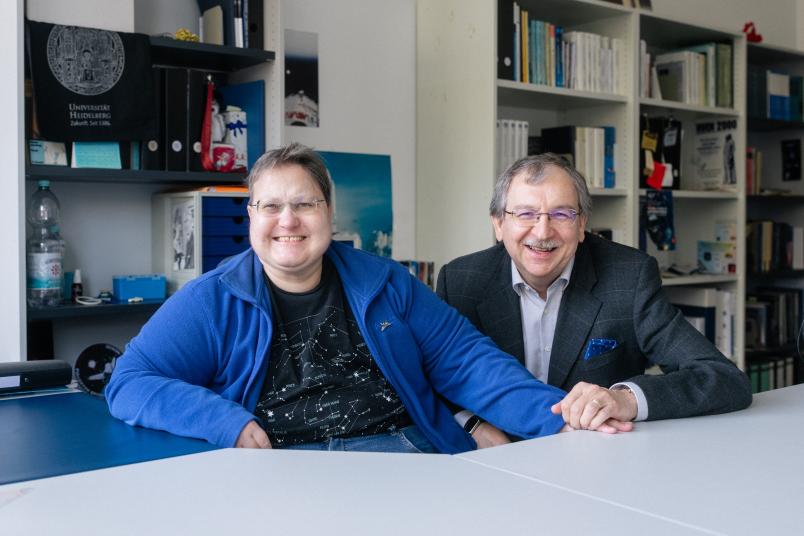
Picture: Lead authors of the publications Dr. Benjamin Stölzner and Dr. Angus Wright (second and third from the left) from Ruhr University Bochum and Dr. Robert Reischke (right), formerly in Bochum, now at the University of Bonn, together with Professor Hendrik Hildebrandt from the Ruhr University Bochum, who oversaw the evaluation of KiDS-Legacy. © RUB, Marquard

KiDS team taken by surprise

According to the KiDS-Legacy data, the matter in Space is distributed somewhat more unevenly than KiDS-1000 had revealed. “Many tests of the internal consistency of the data show that this final analysis is significantly more robust than previous studies,” points out Dr. Benjamin Stölzner from Ruhr University Bochum. The team also compared the new results with those of other surveys. Earlier KiDS analyses had indicated a discrepancy with the Planck Survey, which estimates the matter density based on the cosmic microwave background, a radiation that was emitted shortly after the Big Bang and can still be measured today.

“The discrepancies in our KiDS data set have caused quite a stir in the research community in recent years,” explains Professor Hendrik Hildebrandt from Ruhr University Bochum and coordinator of the KiDS team. “Ironically, we are now resolving this discrepancy ourselves. To our surprise, the KiDS-Legacy data contain no evidence to suggest errors in the standard model of cosmology.” The researchers explain how the differences in the various KiDS analyses come about in the current publications.

Picture: The Kilo-Degree Survey spent eight years observing three areas of the southern sky in great detail. The researchers then used the data to estimate the distribution of matter. Areas with a particularly high density of matter are highlighted in red, areas with a particularly low density in blue. In the center you can see a section of the map in comparison with the size of the full moon. © R. Reischke, K.Kuijken, B.Giblin and the KiDS team